
A colleague of mine recently initiated a move back to New York City, after being displaced by COVID-19. Working from North Carolina, she was able to search online to find a new apartment, negotiate terms with the building manager and start to plan move logistics. All of this happened remotely, and much was accomplished online. Then, in the “last mile” of her transaction, she was informed that she had to appear in person to sign her new lease.
The lack of an option to e-sign was inconvenient in pre-COVID life. In today’s context, it feels downright reckless. Or, at the very least, hopelessly antiquated.
Digital transformation in the financial services sector is not a new topic. I’ve worked in communications and marketing for nearly 30 years now, with 20 of them focused in financial services. From the earliest days of the consumer Internet, the promise of new channels and less friction in financial transactions was clear. It took a long time for broadband to become pervasive, for mobile to mature, for security protocols to be established and rooted in best practices, and for consumer and business behaviors to start to adapt. It’s truly amazing to see how far we have come.
And yet, too many examples remain of financial services and transactions for businesses and consumers that have yet to run the “last mile.”
Running the “Last Mile”
My anecdote is drawn from commercial real estate, a sector comprised of thousands of organizations of varying scale and tech-savvy. For every landlord who still only accepts rent via paper checks, there is another who leverages everything from Zelle to bitcoin.
This case may not apply to core financial processes like banking. But for the end user – here, a consumer – this is a financial transaction. And there are many more examples we can add to the list.
How many corporations still pay suppliers via check? Or, conversely, how many still receive most of their payments in the mail? How many contracts are countersigned by printing a document, signing, scanning and sending back by email? How many restaurants are still unable to accept mobile orders and payments (or feel they are financially unable to do so based on fee structures)? How many, pre-pandemic, were still physically carrying your credit card away with them to the back room to process it?

Not many years ago, I held both a mortgage and a HELOC with the same bank. The communications, statements and online interface for one were modern, highly-functional and self-serve. The other was paper-based only, with statements that appeared to be produced on a mid-century mimeograph.
As marketers, we’re hard-wired to listen to our customers – and to our customers’ customers. It’s our job to translate what we hear back to the leadership of our organizations. To raise the red flag on processes that must be transformed. To seek new and better ways to communicate, as well as to serve customer needs. The term “last mile” does not mean there’s an end point to digital transformation. But there are clear leaps to be made to hit today’s bar of expectations driven higher by COVID-19.
Consumers and Businesses Are Ready
“If not now, when?” No sentiment could more aptly describe the need to push past the final barriers of digital transformation in financial services.
The COVID-19 pandemic has been catastrophic. The loss of life has been devastating; the lingering health impacts challenging; and the economic toll nearly inconceivable. Yet in even the worst of scenarios, there are silver linings. In the context of digital transformation, the silver lining is the lightning-fast shift in consumer and business behaviors and mindsets.
COVID-19 has driven brute-force change. Businesses that would have never thought to go 100 percent virtual suddenly faced shelter-at-home orders. In an instant, paper-based payments arriving via U.S. mail to empty offices became a huge liability. Consumers who had diligently ignored contactless payments scrambled to set up tap-and-go on their phones. In-person visits to a CPA or tax service felt like a big risk. Not having to show up in person to close a mortgage took on a whole new level of urgency.
The pandemic dynamic, as difficult as it’s been, opens the way for change. Consumers and business are ready to adopt new processes and channels. Here are five actions financial services providers can take to assess where these changes in behavior and expectations should drive further digital transformation in their own enterprises:
- Dig Into the Data. Every financial institution or services firm generates immense amounts of data points every day – from tracking transaction types and volumes, to services usage, to customer engagement. Yet this data is often mined and analyzed in ways that remain uneven, inconsistent or siloed. Now is the time to get more strategic in your process of evaluating core data, uncovering vital insights into how behaviors are shifting.
- Ask Your Customers. There’s been a lot of research into how long it takes to form a habit, with timeframes ranging from as little as 21 days to three months or more. We are over seven months into the pandemic in North America. That is ample time for real change in attitudes and actions. Now is the moment to conduct research among your customer base to ask them how their patterns and preferences have changed. Don’t rely solely on third-party research. Go to the source.
- Listen – Carefully and Intentionally. Most organizations now deploy technology and human capital for social listening, particularly in Marketing and Communications. It’s time to double down on these investments and to listen, both deeply and carefully. What are consumers or businesses in your sector saying, liking, debating, criticizing or wishing that you and your competitors would do better? Make it your business to have that digital ear to the ground – and to be more strategic about how you use the insights you glean.
- Look to Adjacencies. Watch sectors beyond financial services to observe what macro changes are taking root. One prime example is healthcare, which is now experiencing a surge in telehealth usage after years of minimal adoption. Our own consumer research at G&S Business Communications, fielded in April 2020, found two in five Americans willing to try telehealth – a number higher than pre-pandemic levels and one that’s continuing to climb.
- Incremental is OK. The very term “digital transformation” can feel overwhelming. But smart change can be fast and incremental. Neil Dhar, vice chair and chief clients officer at PwC, noted in a June article that key digital transformations need not take a decade. He cited the example of a company that “adopted e-signatures in a few days after years of debating the change.”
If Not Now, When?
My apartment-seeking colleague was ultimately able to force the issue and execute her lease remotely. It took a lot of pushing. Too much, given the technology available for secure e-signature plus a legal infrastructure that’s adapted to remote execution of contracts.
There will always be a role for face-to-face interactions, especially once they are deemed safe again. I’ve never banged the “bank branches are dead” drum that’s been sounded repeatedly across the decades. Some so-called “analog” processes are necessary and can provide a better experience for all.
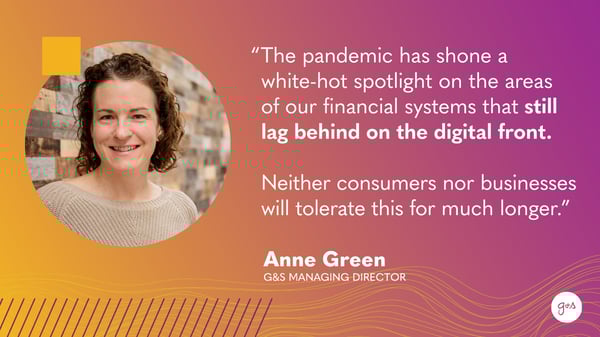
However, it’s high time to remove the needless friction in the system. The pandemic has shone a white-hot spotlight on the areas of our financial systems that still lag behind on the digital front. Neither consumers nor businesses will tolerate this for much longer. Not when the stakes are this high.
Reshaping the Future is our take on what’s next and how we can inspire action and succeed in the “new normal” together. Click here to see our full report, along with fresh data and insights. We’ll help you lead through the future, uncertain as it remains.


