Why the Next Era of Brand Building is Market by Market
For the better part of two decades, global brand building was defined by a simple ambition… consistency at scale.
Best practice was straightforward: one narrative, one voice, one campaign, activated across markets.
It made sense in a world where distribution was fragmented, coordination was complex, and brand equity was built through repetition. But the environment has changed. And with it, the rules.
The New Reality: Two Systems, One Brand
Today’s brands simultaneously operate in two parallel systems:
1. A Global Narrative System driven by:
-
- AI and search
- Global media
- Centralized content engines
- Executive visibility
This system defines how a brand is understood at scale, often before a stakeholder ever engages directly.
2. A Local Trust System driven by:
-
- Market-specific experiences
- Regulatory and cultural context
- Local media and community perception
- Customer and partner interactions
These systems define whether a brand is believed. The challenge is that they often don’t align. And when they don’t, the business consequences are immediate.
The Emerging Gap
In many organizations, the global narrative around a company or a campaign has become increasingly polished. It’s all about clear positioning, strong messaging, and well-produced campaigns.
But at the local level, the experience can vary dramatically.
- Messages that don’t translate
- Proof points that don’t exist
- Claims that don’t match local reality
- Images and photos that are clearly not from the region
- Teams forced to reinterpret strategy on the fly
This creates a growing disconnect between a brand that is well-defined globally, but is inconsistently experienced locally. In a world where trust is built through experience, not exposure, that gap matters. It can mean lost opportunity, lost reputation and lost business.
Why Global Communications Is Getting Harder, Not Easier
Communicating across the globe has always been a challenge, but three forces are increasingly accelerating this challenge:
1. AI Is Amplifying the Narrative
AI systems don’t just distribute your story, they interpret it. They synthesize information from across sources and present a version of your brand and products before you ever enter the conversation. That makes narrative clarity more important than ever.
2. Trust Is Becoming Hyper-Contextual
Stakeholders evaluate brands through local lenses:
-
- Regulatory environments
- Cultural expectations
- Economic conditions
- Community impact
- Regional relevance
What resonates in one market may fall flat, or even backfire, in another if local nuances are not carefully considered and prioritized.
3. Visibility Is Instant, Making Inconsistency Obvious
The gap between global messaging and local reality used to take time to surface. Now, it’s immediate. And often, it’s amplified.
The Shift: From Consistency to Coherence
The answer isn’t to abandon global narratives. And it isn’t to decentralize entirely. It’s to rethink the relationship between the two.
The most effective organizations are moving toward a simple but powerful model: Global Story. Local Proof. Based on decades of experience helping make these two things true at once when it comes to global communications, we’ve coined a term that helps frame this construct. We call it the 85:15 Rule.
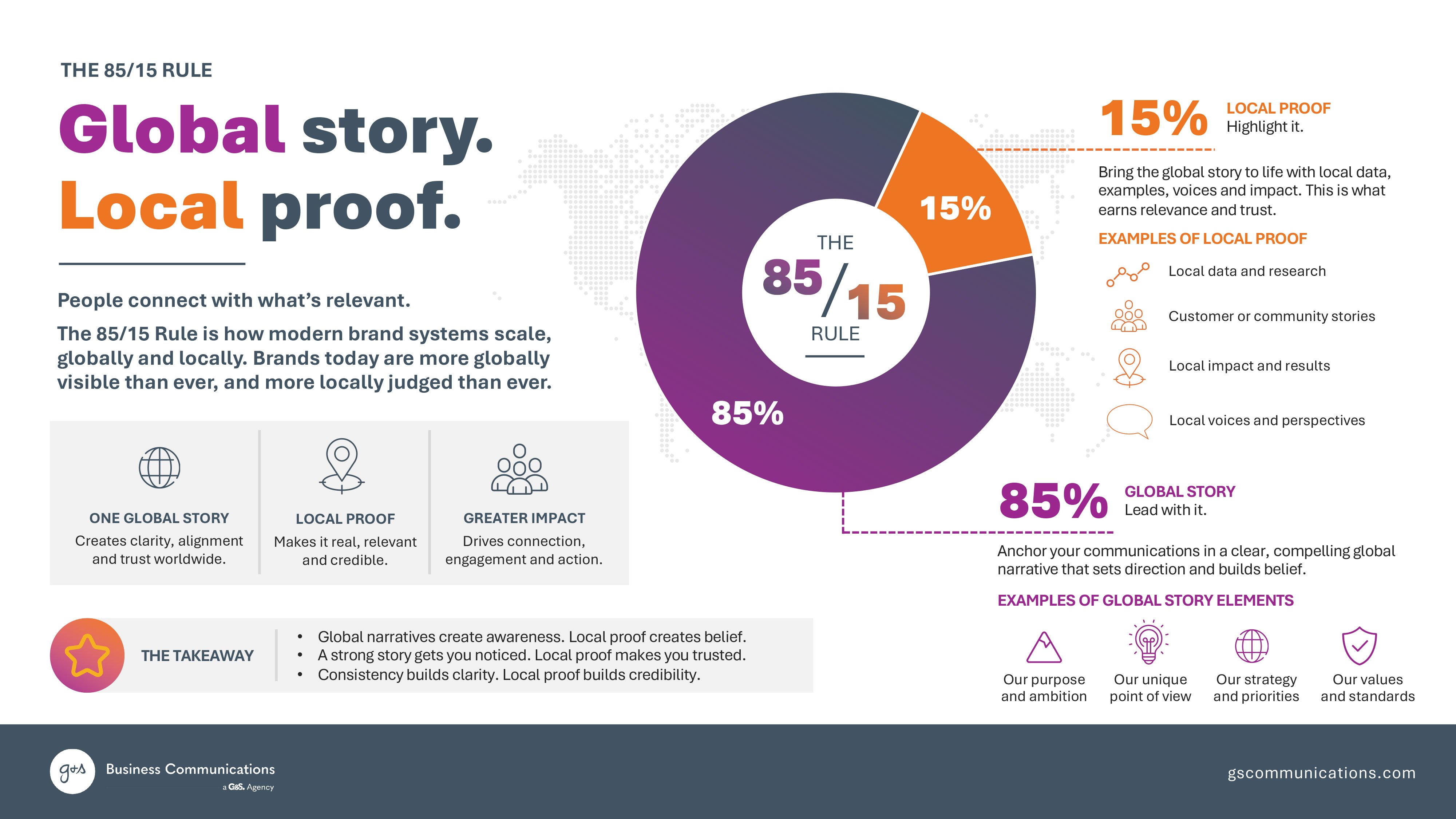
At the center is a clear, durable global narrative, one that defines who the company is, what it stands for, and why it matters.
But that global story isn’t the endpoint. What brings it to life is local proof:
- Market-specific relevance
- Cultural and regulatory nuance
- Customer and stakeholder validation
- Real examples and images from the region
Because in today’s environment, belief isn’t created by what a company says. It’s created by what stakeholders see.
What This Looks Like in Practice
Organizations successfully implementing the 85:15 Rule tend to share a few common characteristics for communications excellence. These include:
1. Narrative Built for Modularity
Not rigid frameworks, but systems that allow adaptation without losing integrity.
2. Clear Guardrails, Not Just Guidelines
Local teams are empowered, but within a structure that ensures alignment.
3. Integrated Operating Models
Communications, marketing, digital, and regional teams operate as a connected system, not parallel tracks.
4. Investment in Local Insight and Communications Assets
Understanding market nuance becomes a strategic priority, not an afterthought. So does ensuring that these nuances are reflected via the use of authentic images in market to reinforce local market relevance and reality.
The Role of Global Communications Is Changing
Global communicators are no longer just responsible for telling one consistent story. Their role carries with it a responsibility to design how the story lives across the organization, and around the globe. This includes:
- Ensuring narrative clarity at the center
- Enabling activation at the edges
- Identifying gaps between message and reality
- Connecting global strategy with local execution
- Making sure the local market reality shows up in regional communications
Communicators should be the connector between global ambition and local truth. They should create frameworks that enable both things to be true at once -- 85% consistency in the global story, and empowered regional teams that have the latitude to tailor around 15% of that global story, and its delivery, to their local reality.
What We’re Hearing from Leaders
In our recent Building Brand Gravity mailbag episode, this theme surfaced repeatedly. Across industries, leaders are grappling with:
- How to maintain a strong global identity while enabling local relevance
- How to create narratives that can flex without breaking
- How to ensure that what they say matches what stakeholders experience
The question isn’t whether to go global or local. It’s how to make both work together.
The Bottom Line
Global narratives create awareness. Local proof creates belief. And in a world defined by speed, transparency, and AI-mediated understanding, belief is what drives perception, reputation, trust, and ultimately, business.
Global brand building isn’t defined by who tells the best overall story. It is best defined by who can make that story true… consistently, and visibly, in every market that matters to the business.